Sophia Slater
Mehemed Fehmy Agha rose to the spotlight when he travelled from Berlin to America to become the new art director for Vogue magazine. The publisher, Conde Nast, had chosen Agha to be the new art editor in three of the most famous magazines of that time; Vogue, Vanity Fair and House and Garden.
The year 1930 was one of great uncertainty for America. The stock market crash in 1929 meant over 15 million Americans had no source of income. This was a global disaster and many felt there was no solution in sight. This was around the time Agha took over Conde Nast productions and Vanity Fair. The magazine was understandably not selling well at this point, which drove Agha to make some revolutionary design changes to excite the readers again.
During the 1930’s, Art Deco had a huge influence on the early covers. This style was funded in France and made its way to New York featuring geometric shapes and bold contrasting colours. With the development of sky scrapers and architecture came new metallic surfaces and more dulled down colours. This is evident in the 1930 cover as the crisp cut outlines and faded colours create a geometric effect.
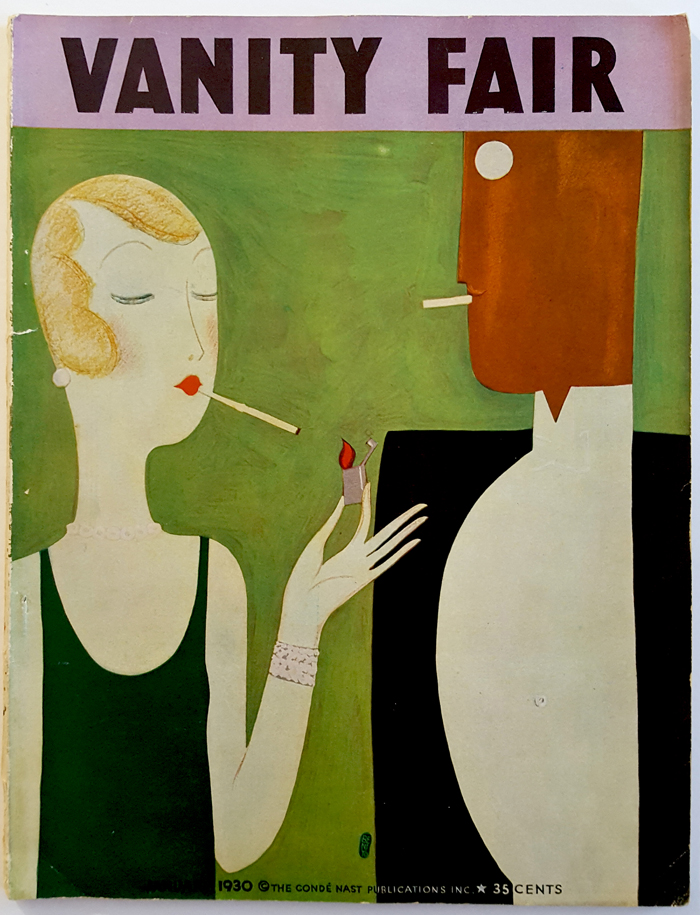
The January Vanity fair cover in 1930 is one of Agha’s earliest works for the company. The illustration by Eduardo Garcia Benito, shows a woman lighting a cigarette for her male partner. The green cover gives a freshness and relaxed mood to the viewer, possibly as an ode to the new year. Compared to his later works this one is more tame of Agha’s designs, the colour scheme and subject matter are more comfortable. The sans serif text at the top (a staple of Vanity Fair’s typography) catches the viewers eye in it’s heavy font. To me, this cover looks more like a cigarette advertisement than a high fashion cover. The colours are very subdued which dulls down any excitement of the reader. Although, the crisp lines and block shapes are very modern and unique for that time period.
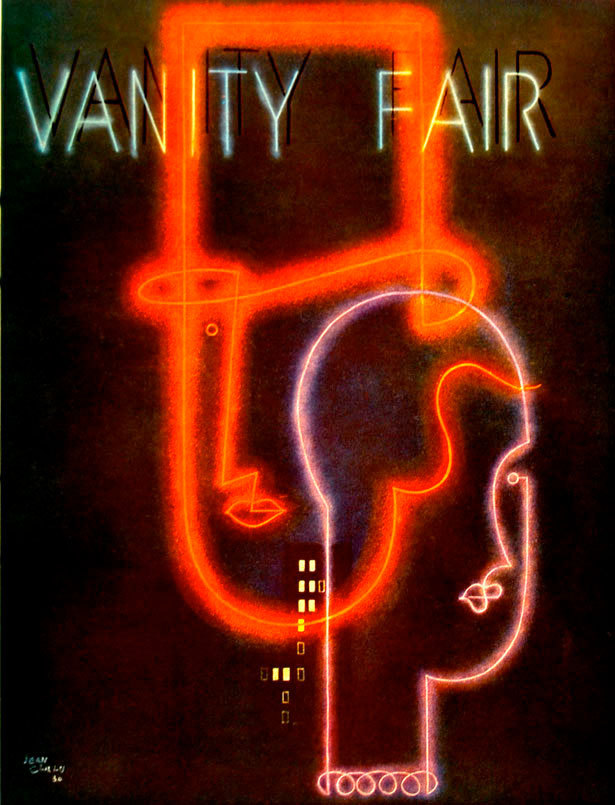
In 1931, Jean Carlu, a French graphic designer, created the April cover. Carlu is known for his cubist inspired art, particularly patriotic posters. What drew me to this piece was the high level of sophistication in the design. The 1929 font heavy ‘Vanity Fair’ is replaced with a skinny neon effect font with drop shadow. This gives the illusion that the text is glowing in the dark. The image appears to be a man and woman face overlapping, with simplistic features that give it a contemporary twist. Compared to Agha’s 1929 design this style is a lot more dramatic and intense, like a New York street night.
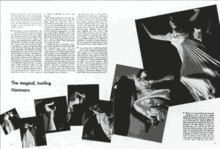
Not only did Agha reinvent Vanity Fair covers, but he also paved the way for graphic designers to use techniques we use to this day. Through his work with Vogue, he introduced the first ever double page spread along with photos continuing over the edge, otherwise called bleed. These techniques gave the magazine a new lease of life as well as capturing the viewer’s interest. The Double page spread leads the eye seamlessly across with no sense of guidelines. Overall, this makes the magazine more easy to read and navigate through large volumes of text and accompanying pictures. Also noticeable, is the generous use of white space. This puts emphasis on the surrounding text and images and makes the article more inviting to read altogether. There is no crammed feeling with previous, older issues and Agha has really thought out how relaxed he wants the readers to feel.

When Agha took over Conde Nast publications he disapproved of the magazines traditional, outdated style. He traded the italics for Sans Serif fonts like Futura in order to appeal to the young, impressionable audience. This heavy font fits with the magazine’s slick, classy brand image as well as being easy to interpret articles quickly. It ties in nicely with Agha’s simplistic trademark style as the font letters are the bare minimum but still timeless and crisp.
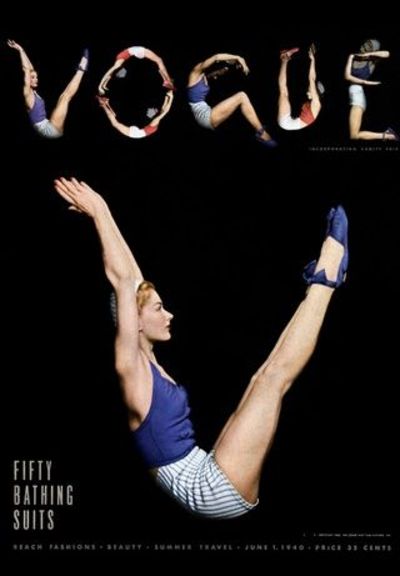
Fast forward to 1940 and Agha is still challenging and breaking the barriers of modern magazine covers. The 1940 issue ‘Fifty bathing suits’ replaced the traditional ‘VOGUE’ font with photographed women showing the letters. This cover is more couture fashion than Agha’s previous Vanity Fair issues, there is more sex appeal than the previous man and woman covers. I think this is a really unique idea that had never been done before and is reminiscent of Agha’s ability to defy previous design rules. The crisp, cropped images contrast harshly with the black background. The result is a dramatic, female empowering cover that the reader can picture themselves rocking a bathing suit. I prefer this approach to the more toned down Vanity Fair illustrations. Although conducted by the same designer, this 1940 cover has a sense of maturity and elegance through the images which is absent in Vanity Fair. This could be due to Vanity Fair being more unisex whilst Vogue’s audience was more high class women.
In conclusion, I think Mehemed Fehmy Agha is the dark horse of the design world. Agha was a previously unheard name to me, despite Vogue and Vanity Fair being two of the biggest global magazines in 2018, notably almost 90 years after he was editor. I think his designs are quirky and a complete refreshment compared to the mainstream photograph models we see in today’s Vanity Fair. Agha picked up on 1930s trends in his own way and made the magazine as contemporary and fun as possible. Looking deeper than the cover, it is a shame that his invention of the bleed and double page spread are so uncredited. It is these techniques that make inch thick magazines so readable and inviting to today’s screen addicted generation.
References:
http://www.magazinedesigning.com/mehemed-fehmy-agha-first-art-director/
https://www.history.com/topics/great-depression/1930s


